The inability to look at AI as a tool or a technology whose future is yet to be determined is a path to failure. The future of work and broader society depends on our ability to look objectively and holistically in deciding how we want to utilize rapidly evolving tech versus jumping to conclusions based on sensationalist headlines and vibes.
AI has at least three diverging narratives talking past each other.
Layer 1:
The first is the simplistic Doom or Hype statements that don’t represent reality. However, they have a strong hold on public sentiment. Bad actors of many stripes are exploiting this to their advantage by making it the backbone of political campaigns in either direction or justifying ever-increasing resource needs or mass layoffs. This crowds out the nuanced truths crucial to building a shared future that benefits most people.
Examples like the below lock out most of the public from any actionable step:

- We are Doomed: Employment Apocalypse
- AI Doesn’t Actually Work: Cherrypicked Failures or Gotcha Posts
- The Absurdist Narrative: Allbirds, Inc. Executes $50M Convertible Financing Facility Agreement; Announces Expansion into AI Compute Infrastructure
- AI as The Next Frontier of Opportunity: Economic potential of generative AI | McKinsey
- AI is a Rocket Ship: ‘A rocket ship.’ AI is doubling software output, and code quality is holding up
- AI Will Save the World: Why AI Will Save the World | Andreessen Horowitz
What these narratives have in common is a failure to separate AI as a technology from its potential impacts on humanity. They also generally don’t treat it as a technology that is still evolving or acknowledge that its future is being shaped not only by the elite but by regular people.
This is because a lot of well-meaning people are failing to separate their personal feelings and fears as well as the politics of and behaviors of certain companies and individuals whose viewpoints people consider toxic versus trying to understand an 80+ year field that has only splashed onto mainstream consciousness.
It’s important to separate the politics and suppositions of what AI could be versus what it is as a technology. History teaches us that those who have tried to ignore or fight fundamental technology changes have never fared well.
It isn’t to say that there are no concerns, but it’s important to actually note what the key concerns are, mitigate them, and find opportunities where our lives could be potentially better off such as advancements in medicine.
A lot of what drives this first layer is a second layer. Technologists making the most of AI are generally disconnected from the general public, simply because they’re having a completely different experience of AI. The public feels like AI means fewer jobs and more expensive electricity bills. They use LLMs and find they hallucinate. Companies and politicians are finding being anti-AI is a stance that helps their prospects.
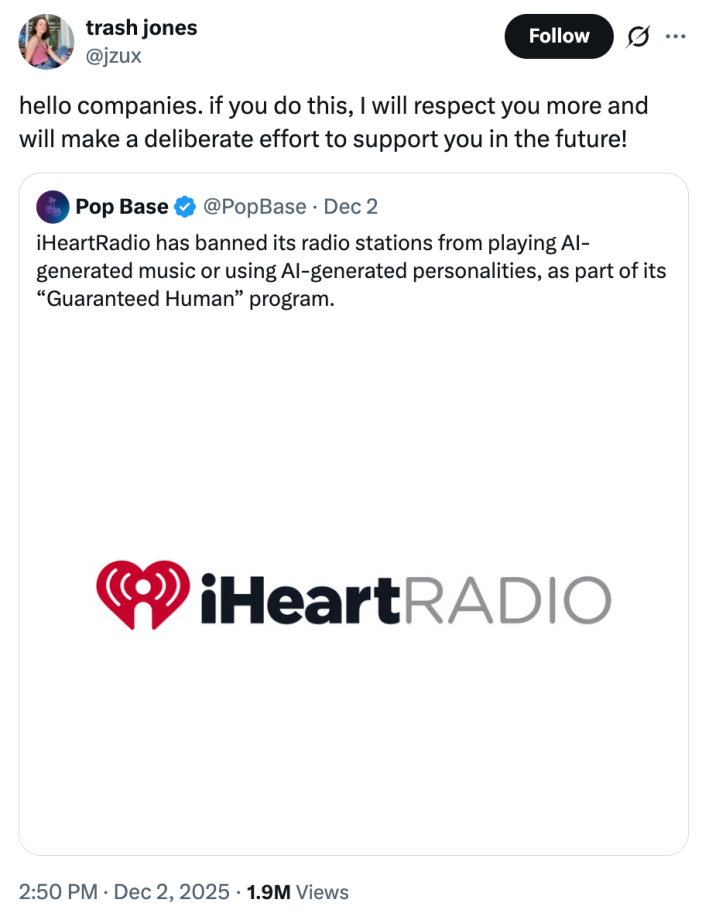

Layer 2:
While it’s important to move past this first extreme emotional hype-driven layer, the general public doesn’t have the same experience as deep practitioners who can watch their projects and dreams come to life with agent orchestration.
From the abstract to the specific, an example from my own experience: analysis of streaming signal data that once took a team hours manually looking through rows of data could now be done by trained agents that dropped the time spent by 70% and also revealed trends not previously discovered with manual human review.
Examples like this from industry workflows illustrate the gap between skeptics that cherry picked failures from LLMs and people deep into computer science. This asymmetric information gap in knowledge and lived experiences between the first and second layer leaves the general public without much useful guidance.
Layer 3:
The third layer is where most of us should live. This layer is understanding that AI is a technology that will have a far-reaching impact depending on how we utilize it as a tool. A hammer can build or destroy. The choice is up to us. But I certainly don’t want the doomers and hype artists to have all the hammers. Monopolies of anything, including ownership of resources or ideas, have never worked out well for most people.
Businesses, governments, and those in society who look at AI as a technology with a curious, expansive, utilitarian, but realistic mindset grounded in facts will be the ones who will come out ahead and hopefully shape AI’s impact on society more toward positive than negative outcomes.
Creative destruction will be painful, but it doesn’t have to result in a doomer digital serfdom scenario. For example, the pushback against data centers should compel industry to find more efficient technologies and build economies of scale to cool down these energy hogs versus accepting the inefficient methods of today.
Here’s what Layer 3 actually looks like in practice. Professor and tech exec Terry Kramer at the UCLA Easton Technology Management Center offers a framework for understanding new technology by how it impacts customers, enterprises, and society.
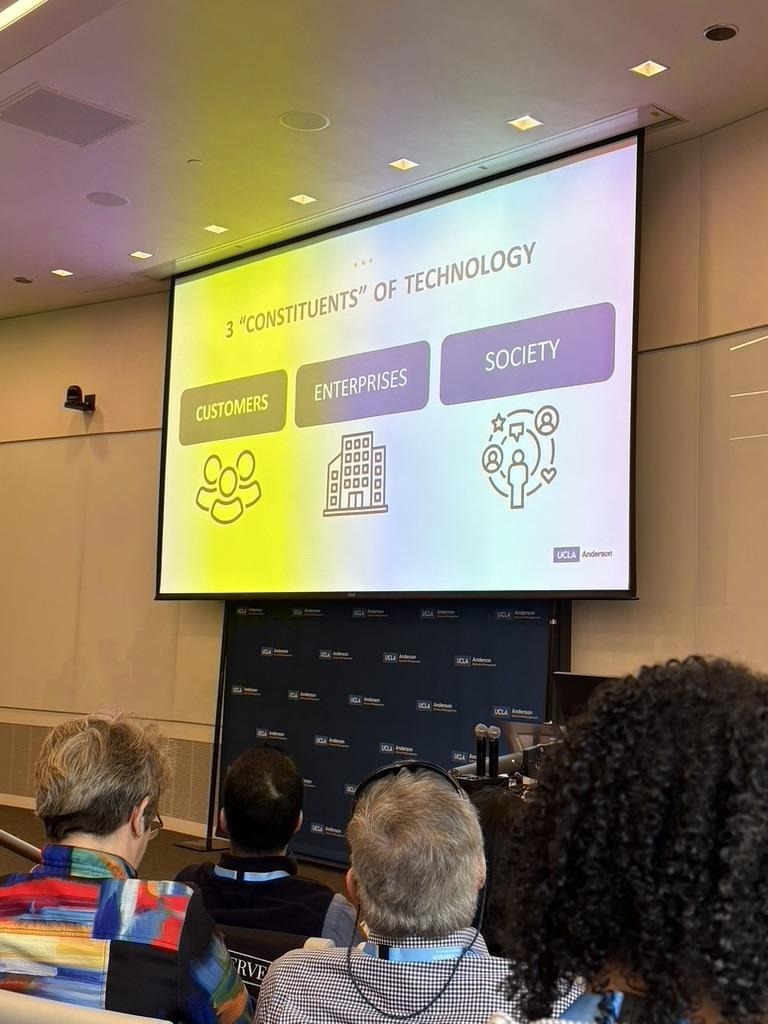
As someone who considers herself a practitioner, not an AI expert, I operate in this space and use a lens like this to understand my day-to-day work.
With customers, I can see that companies rightfully want AI to solve the problems AI is currently best suited for: manual rote tasks that people are bad at doing, dislike, and that computers could do better, which companies struggle to pay people good wages for, e.g., a lot of manual work being done in Excel today.
However, it’s not so much that the technology isn’t ready for this in many cases – it’s the lack of understanding of AI and organizational structure where many businesses are crashing into reality. Management systems and entire workforces are not ready to evaluate or adopt tools. Society needs to prepare for a transformation of workforces unseen since the industrial revolution.
Employees, many of them rightfully, see it as a threat to their jobs instead of seeing it as an opportunity to get rid of dull repetitive tasks and more paid client work. On one hand, we see people all too willing to outsource their thinking to AI versus using AI as a tool and employers willing to treat expertise, institutional knowledge, and company culture as disposable or something a lifeless blob of code can replace.
On the other hand, enterprises who are AI-native and entrepreneurs are seeing wins.
My first suggestion for individuals to understand AI is that it’s not just ChatGPT, Gemini, and Claude.
For example, those who have concerns about data privacy can run their own local models at home on their computers today. This diffusion of adoption also potentially saves us from the consolidation we saw in the last wave of tech, which left too few players and too little choice. AI need not be dominated by the few and be more democratic than people think.
The second is to study the history of past technology shifts. Read books like The Second Machine Age, Empire of AI, and Co-Intelligence: Living and Working with AI and seek out different perspectives on AI beyond hot takes. It’s also worth looking at Claude’s AI Constitution or publicly available papers on how AIs are taught to think. These don’t require being an expert hacker or hundreds of hours to make you better off as an everyday person navigating the age of mass AI.
The future of work and industries depends on us looking beyond the surface. Vibes might fuel the headlines, but only a grounded, realistic strategy will build the future. Everyday professionals, creators, and thinkers should be learning, experimenting with, and co-creating the future of AI.