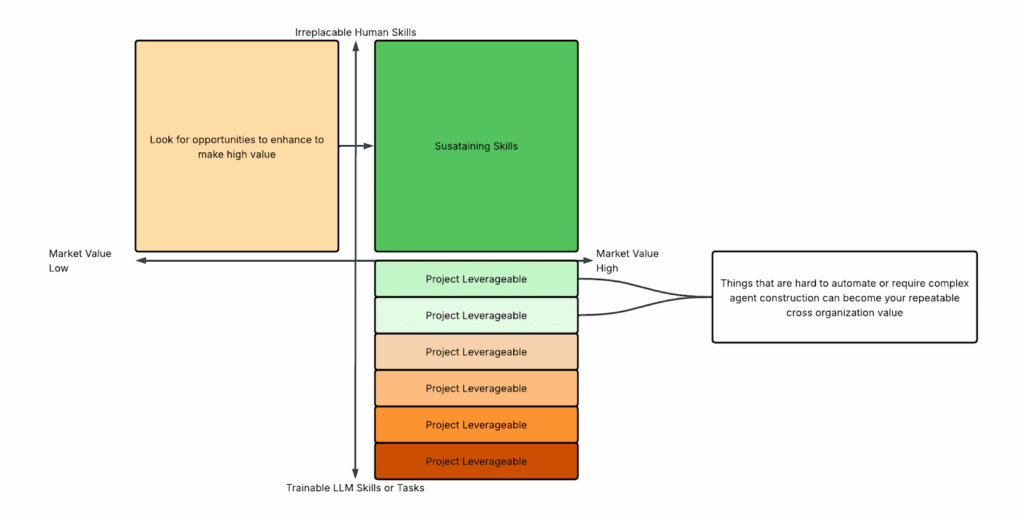
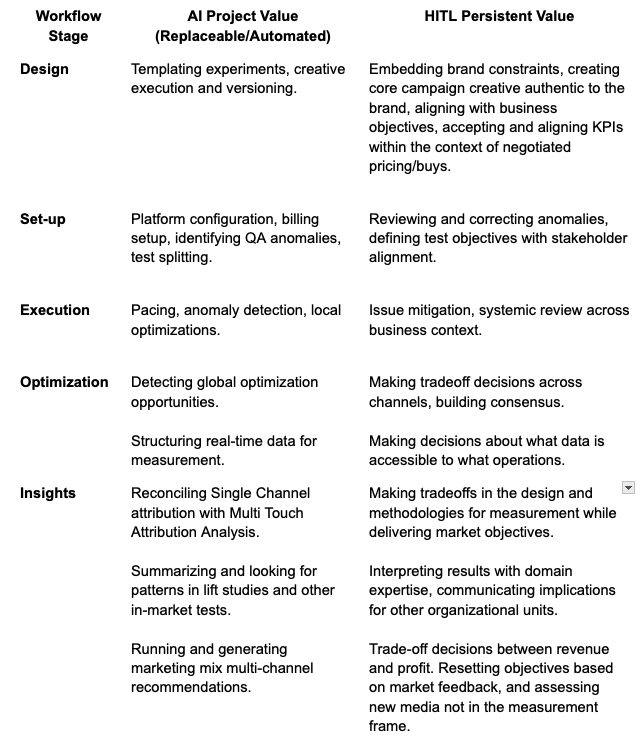
The rapid evolution of generative AI has ushered in a new workplace reality where individual employees wield powerful autonomous tools, AI assistants and agents, that often rival corporate infrastructure. At Humanleverage.ai, we are defining a structure informed by our research that formalizes Bring Your Own AI (BYOAI) into a deliberate governance and workflow model designed to separate individual thinking from institutional execution. Rather than wait across 15+ years of integration and adoption as in the mobile device cycles, we should design for a state that is ideal and aligned to human behavior with AI.
Unlike common industry descriptions that treat BYOAI as a synonym for “Shadow IT,” the Humanleverage.ai model treats it as a compartmentalization strategy for human and organizational agency and the cognitive tools of those agents. It moves away from the “shadow” era, characterized by workers secretly using unmonitored individually acquired tools, and toward a mature state similar to the later stages of Bring Your Own Device (BYOD) in the mobile transformation of the workplace.
Who Should Care and Why
This matters to every leader and knowledge worker operating at the intersection of human judgment and AI-enabled performance. Governance must harness agentic horsepower without eroding institutional integrity; The BYOAI framework enables innovation at the edge without sacrificing safety or quality. The question is no longer whether these tools improve output, but whether organizations are structured to recognize, govern, and protect both human and institutional intelligence. Without clarity, intelligence scales faster than trust. With it, BYOAI becomes a force multiplier for judgment, velocity, and durable professional relevance.
Defining BYOAI: Zones of Architecture
Technically, BYOAI for Humanleverage.ai is defined by four distinct zones of operation and the bridges that connect them. This architecture ensures that work safely moves from individual cognition into enterprise systems without ambiguity or leakage.
Zone 0: Individual AI Workspace (Non-Corporate): This is the user’s private cognitive space for pure ideation and learning. It is explicitly out-of-scope for the corporation, containing no corporate data and requiring no audit.
Zone 1: Individual AI Workbench (Pre-Assimilation): This is the “Agent in the Backpack.” It is a declared and permitted AI environment used for drafting, modeling, and reasoning. Crucially, while it is work-aware, it has no write-access to corporate systems of record.
Zone 2: Enterprise AI Artifacts: This is the handoff point where individual output is intentionally promoted into corporate control.
Zone 3: Operational & Production Enterprise Systems: These are the fully integrated, depersonalized institutional systems where individual continuity ends and institutional continuity is prioritized. Examples would be checked-in/deployed code, production systems, operational results, codified knowledge artifacts, managed data stores, and the like.
BYOAI vs. Shadow IT: The Critical Distinction
The BYOAI defined zones allow a diverse range of AI usage within an architecture the opposite of Shadow IT:
1. Declared vs. Hidden: Shadow IT is undeclared and unbounded. The BYOAI model is explicitly zoned and enforced, centering governance around the activity rather than attempting to police private cognition.
2. Explicit Transitions: In shadow IT, IP ownership is ambiguous. In the BYOAI model, ownership transfer occurs at a clearly defined promotion point (the Zone 1 to Zone 2 bridge), where explicit user action and security scanning are required.
3. Governance of Boundaries: Shadow IT hides from governance; BYOAI is built to make human judgment legible. It provides a declared, observable surface where policy can be enforced without surveilling every thought.
4. IP Protection: Shadow IT risks corporate IP leakage into public models. The BYOAI framework uses bridge controls, such as identity assertion and tool allow listing, to prevent data leakage while maintaining the worker’s “cognitive sovereignty” in Zone 1.
Corporate Constraints and the Need for “Seams”
Enterprises face significant constraints distinguishing reliably created vs. improperly created knowledge worker outputs that have been AI enabled in some capacity (“Slop” being a major category of those errant creations). While traditional shadow IT ignores these risks, the BYOAI framework addresses them by creating “seams” in the workflow. In a shadow IT environment, thinking and executing collapse into a single, unmanaged surface where accountability blurs. The Humanleverage.ai model uses Zone 1 as a buffer where high-velocity cognition can occur, but risks are surfaced before commitment to the system of record. This prevents “brittle workflow AI” by ensuring that institutional systems (Zone 3) only absorb stable, depersonalized, and vetted artifacts.
BYOAI acknowledges how humans actually work, building systems hygiene that creates clarity aligned to that workflow, and as a result reduces adoption concerns and gaps. By focusing enforcement on the transitions between zones, organizations gain lower real-world risk, stronger IP claims, and higher trust with optimized, minimum friction through work processes.
In short: Shadow IT is an attempt to sneak past the rules; BYOAI is an invitation to work within a framework where the rules are clearly posted on every door of the Enterprise.
Corporate Constraints to BYOAI Adoption
In today’s complex enterprises, the corporate constraints against unmanaged BYOAI adoption are rooted in the imperative to maintain operational integrity, security, and legal compliance.
One primary constraint revolves around data security and regulatory compliance. Many proprietary AI tools rely on user inputs to train and operate, posing a major risk to sensitive company information. For instance, individuals using free or external AI models like ChatGPT risk feeding personal information, financial data, or other proprietary details into systems that are not designed for corporate data protection. In highly regulated fields like medicine, legal and regulatory requirements, such as those concerning Protected Health Information (PHI) and HIPAA, present nontechnical barriers that prevent wholesale AI displacement and tightly constrain individual usage. As an oncologist noted, if a personal GPT is trained on big data containing PHI, the institution may assert that the data and the resulting AI model belong to them, hindering the researcher’s ability to move jobs.
A second critical constraint is the lack of robust governance and standardized workflow logic across complex organizational processes. AI models, while powerful, are fundamentally probabilistic, leading to a much lower tolerance for error in business-critical processes compared to casual use. AI systems struggle with unstructured logic, conditional triggers, and understanding the implicit organizational context necessary to follow complex business workflows. This is evidenced by failures where AI assistants have omitted necessary steps, like a mandatory compliance attestation, because the model lacked understanding of why that sequence and conditional logic mattered in a regulated process. When policies shift, fine-tuned models—whether corporate or individual—can become “brittle workflow AI”.
Finally, the challenge of maintaining quality control amidst AI-generated “slop” constrains enthusiasm for unmanaged tools. While AI can easily generate large volumes of content, it often produces text or code that contains hallucinations, logical errors, or simply lacks the necessary nuance and quality. This forces human workers to spend time manually checking and correcting AI output to maintain professional standards, sometimes negating the efficiency gains initially promised.
Despite these constraints, the adoption of personal AI tools offers transformative benefits for the average worker, similar to how mobile devices brought unprecedented flexibility and access to information.
1. High-Speed Research and Knowledge Synthesis: AI tools function as an external “second brain” or highly capable machine, allowing workers to externalize research and synthesize massive amounts of information instantly. For workers like a urologic oncologist, specialized AI interfaces dramatically reduce the time spent searching databases like PubMed, enabling quick access to obscure research articles or clinical evidence necessary for real-time decision-making in the clinic. This access to deep, rapid research enhances the quality of professional output.
2. Automation of Tedious and Menial Tasks: AI agents excel at structured, repeatable, and data-heavy tasks, freeing humans to focus on higher-value activities. For software developers, tools like GitHub Copilot or general LLMs can write micro-processes, assist with complex coding syntax, and debug code, saving hours of typing and tedious error correction. Similarly, professionals across fields gain capacity by offloading low-value, time-consuming tasks like bookkeeping, drafting emails, summarizing long documents, and automating data entry into customer relationship management (CRM) systems.
3. Enhanced Productivity and Output Quality: AI acts as a force multiplier, allowing individuals to achieve objectives that would otherwise require multiple staff members or substantial resources. For independent consultants or solopreneurs, AI allows them to operate with a “leaner team,” generating content, managing social media, and executing strategic research in a way that previously demanded a team. This enhancement allows workers to leverage their time for strategic thinking and customized client service rather than surface-level generic preparation.
Major Challenges of Bring Your Own AI
While the benefits are clear, allowing individual employees to introduce their own AI systems presents significant organizational challenges.
1. The Crisis of Trust, Reliability, and Accountability: When AI hallucinates or fails, the consequences in a business setting can be severe, yet assigning accountability becomes complex. Workers report that unmanaged AI tools, especially when used for research or data analysis, frequently introduce errors, fabricate citations, or fail logic checks. One user noted that even after repeatedly training an AI tool on a precise request, it would perform differently, or worse, unilaterally edit the underlying text in unintended ways, creating a vicious cycle of correction. The lack of intrinsic accountability in AI—it cannot suffer consequences for screwing up—means that human operators must always remain “in the loop” for judgment and verification, potentially negating the perceived efficiency.
2. The Human-AI Paradox and Talent Management: The use of personal AI assistants creates a profound tension known as the Human-AI Paradox: workers must improve their AI tools to remain competitive, yet the better the AI gets, the more easily the worker’s role can be replaced. This raises questions about how organizations should protect human capital and incentivize agent training, moving toward an era of agentic work. Furthermore, unmanaged AI adoption can contribute to an environment of constant layoffs and a culture of fear, as executives aggressively pursue efficiency cuts based on AI’s perceived capabilities, often without developing proper change management plans or recognizing the chaos introduced by new tools. This efficiency-first approach risks “automating out the very authors of tomorrow’s innovations”.
The BYOAI Humanleverage.ai is proposing coupled with the appropriate technically enabled enterprise governance, allows the “Agent in the Backpack” to have transformative benefits:
Unlike unmanaged or one-sided management of AI, which risks “automating out” creators and or creates ambiguous risk profiles for IP, this model incentivizes agent training as a form of professional autonomy that remains connected to institutional outcomes.
• Proper expectation setting with a vernacular to discuss those expectations between the enterprise and the work contributor
• Trust Structures between Organization and Individual
• Preservation of Human Capital with Connected Autonomy and Clear Moments of Transfer of Control
Ultimately, the constraint for today’s businesses is finding the necessary balance: harnessing the exponential power of individual, customized AI tools without sacrificing the foundational human qualities of contextual judgment, accountability, and reliability that ensure long-term value and effective collaboration.
Afterword
I would like to acknowledge the helpful contributions from Charles Mi to this article as well as other colleagues who reviewed it and made suggestions. The section “Who Should Care and Why” was added 3 weeks after original publishing based on such feedback. Thank you.